
Posted on 05 November 2010. Tags: aspiration, corticosteroid, CPT code, depo-medrol, housemaid's knee, ICD-10, ICD-9, injection, Kenalog, pain, prepatellar bursa, prepatellar bursa injection, procedure, steroid, technique
By Chris Faubel, MD –

This patient does NOT have prepatellar bursitis. Image shown only as an example of needle placement.
aka “Housemaid’s knee injection”, “Prepatellar bursitis injection”, Prepatellar bursa aspiration”
Indications
- Prepatellar Bursitis / Housemaid’s Knee
- ICD-9 code:
- 726.65 “prepatellar bursitis”
- ICD-10 code:
- M70.41 “prepatellar bursitis, right knee”
- M70.42 “prepatellar bursitis, left knee”
CPT code: 20610 “Arthrocentesis, aspiration and/or injection; major joint or bursa”
Materials Needed
- Gloves (non-sterile)
- Alcohol swabs (or betadine)
- Band-aid
- Numbing

This patient does NOT have prepatellar bursitis. Image shown only as an example of needle placement.
- Ethyl chloride “numbing” spray
- 27-gauge 0.5″ tuberculin needle with syringe – for the skin wheal
- Fill with 1-ml of 1% lidocaine
- Aspiration
- 20 or 18-gauge 1.5 inch needle with 3-ml syringe [for aspirating and injecting] — may need larger syringe for aspirating
- Injecting
- Same needle as above, with new 3-ml syringe
- 1-ml of 40mg/ml Kenalog or Depo-Medrol
- 1–ml of 1% lidocaine
Note: If the patient has a fever, and/or the skin over the bursa is erythematous, warm, and swollen, it is NOT recommended to inject any steroids.
Technique / Procedure Steps
- Always start with informed consent from the patient, and then a time-out to verify correct patient and injection site.
- Patient position: Perform with patient seated and knees over edge of table, OR, lying supine with the knee slightly flexed (towel roll under knee)
- Mark the injection site with a pen tip to leave an impression mark.
- Clean the skin thoroughly with as many alcohol swabs as needed (usually only 1-2 are needed). Or clean with betadine and allow to dry completely.
- Spray ethyl chloride or other “numbing” spray over the injection site.
- With the tuberculin needle/syringe, enter nearly parallel to the skin over the injection site and create a skin wheal with 0.5ml 0f 1% lidocaine. Then advance the 0.5″ needle in the direction the injection needle with take, and anesthetize the bursa.
- If aspirating, use an 18 or 20-gauge needle and enter perpendicular to skin, into the bursa. Aspirate as much fluid as possible. If only injecting, you can use a 25-gauge needle.
- After aspirating, keep that needle in the bursa, and switch to the corticosteroid/lidocaine syringe.
- Inject the full contents of the syringe. Should flow easily.
- Withdraw the needle after syringe if fully empty, and apply band-aid.
Tips
- Finding the injection site
- The bursa should be rather obvious; but it usually resides over the anterior patella (inferior half).
- Numbing the skin
- Find out all about “Taking the Sting Out” (of injections) by going here.
- As noted above, use ethyl chloride (or other freezing spray), as well as a skin wheal to reduce the pain of this injection.
- After the injection
- Have the patient flex and extend their knee while you throw away supplies.
- Explain to the patient that the lidocaine will wear off in an hour or so, and that they may be back to their normal pain until the steroids start kicking in (anywhere from 1-7 days) — though just aspirating the fluid will help with the pain right away.
- May also ask the patient to not kneel or apply any direct pressure on the patella for 12-24 hours.
Related Content:
Posted in Lower Extremity, Prepatellar Bursa, Procedures
Posted on 03 November 2010. Tags: code, corticosteroid, CPT, depo-medrol, DIP, distal interphalangeal joint, ethyl chloride, finger, ICD-10, ICD-9, injection, Kenalog, osteoarthritis, procedure, Rheumatoid arthritis, steroid
By Chris Faubel, MD –
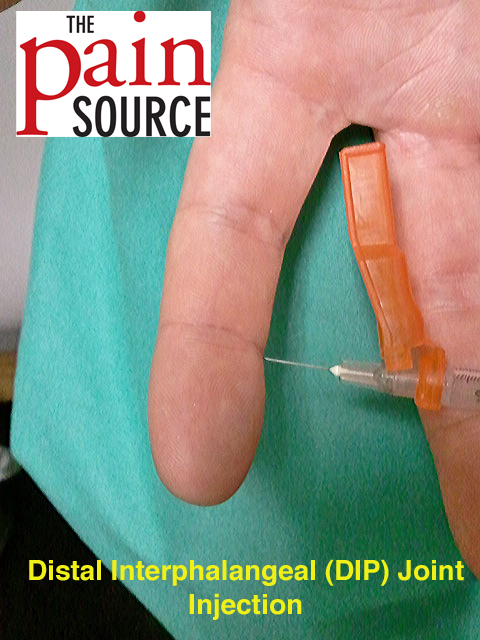
aka. “DIP injection”

Just need to get the needle under the joint capsule.
Indications
- Osteoarthritis (painful) of the distal interphalangeal (DIP) joint
- Rheumatoid arthritis of the distal interphalangeal (DIP) joint
- **see all ICD-9 and ICD-10 codes at end of post
CPT code: 20600 “Arthrocentesis, aspiration and/or injection; small joint or bursa (eg, fingers, toes)”
Read the full story
Related Content:
Posted in Distal Interphalangeal, Procedures, Upper Extremity
Posted on 02 November 2010. Tags: big toe, CPT code, depo-medrol, gout, great toe, ICD-10, ICD-9, injection, Joint, Kenalog, metatarsophalangeal, MTP, osteoarthritis, pain, procedure, steps, tuberculin syringe, turf toe
By Chris Faubel, MD –

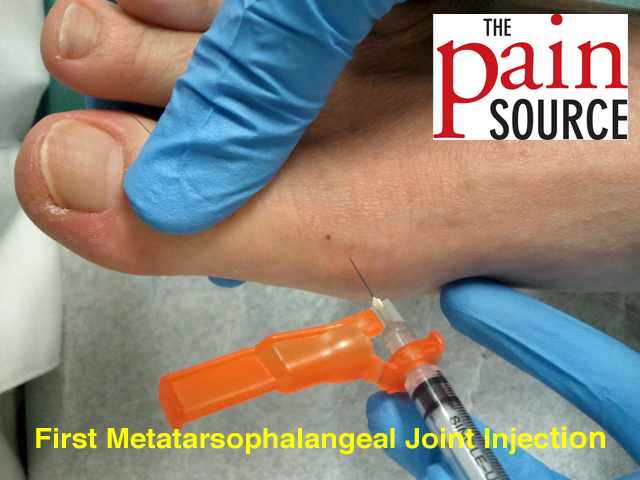
Just need to get the needle under the joint capsule, not necessarily inside the joint.
aka. “Great toe injection”, “Big toe injection”
Indications
- First metatarsophalangeal (1st MTP) joint painful osteoarthritis
- Gout (in the “great toe” joint) — most common location
- Turf Toe
- **see all ICD-9 and ICD-10 codes at end of post
CPT code: 20600 “Arthrocentesis, aspiration and/or injection; small joint or bursa (eg, fingers, toes)”
Materials Needed
- Pen – clicking type
- Gloves – non-sterile
- Alcohol swabs (or povidone-iodine)
- Band-aid
- Tuberculin needle/syringe OR 1-ml syringe with 25-gauge 5/8″ needle (depending on body habitus)
- Injectate
- 0.5-ml of 40mg/ml Depo-Medrol or Kenalog (or 0.5ml of 6mg/ml Celestone)
- 0.5-ml of 1% lidocaine
Technique / Procedure Steps
- Always start with informed consent from the patient, and then a time-out to verify correct patient and injection site.
- Mark the injection site with the pen tip in order to leave an impression in the skin.
- Clean the skin thoroughly with as many alcohol swabs as needed (usually only 1-2 are needed).
- Patient position: Perform lying supine with the foot off the end of the table, OR, supine with knee bent and foot flat on the table.
- With the tuberculin needle/syringe, enter perpendicular to the skin. If bony resistance is met, redirect the needle until you feel you are inside the joint. Note: Ultrasound may be needed if extensive osteophytes make it difficult to find an entry path. Also, the needle tip does NOT need to be inside the joint; just under the capsule surrounding the joint.
- Aspirate to make sure you’re not in any vessel.
- After negative aspiration, inject the full contents of the syringe. Should flow easily.
- Withdraw the needle after syringe if fully empty, and apply band-aid.
Tips
- Finding the injection site
- Can palpate the joint space best on the medial surface.
- May help to distract the phalanx distally to open the joint space.
- Numbing the skin
- Find out all about “Taking the Sting Out” (of injections) by going here.
- Since I use a tiny tuberculin needle, most patients have no problem with the injection and don’t need any extra lidocaine skin wheal or freezing spray.
- I tell them numbing the skin with lidocaine will probably hurt more than the actual injection.
- Because this is a sensitive area, ethyl chloride “numbing” spray may be used.
- After the injection
- Have the patient move their toe around while you throw away supplies.
- Then, re-mobilize the 1st MTP joint so they can see the immediate results of the lidocaine.
- Explain to the patient that the lidocaine will wear off in an hour or so, and that they will be back to their normal pain until the steroids start kicking in (anywhere from 1-7 days).
- May also ask the patient to not do much activity on that foot for 12-24 hours.
Diagnostic Codes
- First metatarsophalangeal (1st MTP) joint painful osteoarthritis
- ICD-9 codes:
- 715.17 “osteoarthrosis, localized, primary, ankle and foot”
- 719.47 “pain in joint, ankle and foot”
- ICD-10 codes:
- M19.071 “primary osteoarthritis, right ankle and foot”
- M19.072 “primary osteoarthritis, left ankle and foot”
- M79.674 “pain in right toe(s)
- M79.675 “pain in left toe(s)
- Gout (in the big toe joint)
- ICD-9 code:
- 274.0 “gouty arthropathy”
- 274.9 “gout, unspecified”
- ICD-10 code:
- M1a.071 “idiopathic chronic gout, right ankle and foot”
- M1a.072 “idiopathic chronic gout, left ankle and foot”
- M10.071 “idiopathic gout, right ankle and foot”
- M10.072 “idiopathic gout, left ankle and foot”
- Sprain of first metatarsophalangeal joint (turf toe)
- ICD-9 code:
- 845.12 “sprain of metatarsophalangeal (joint) of foot”
- ICD-10 code:
- S93.5 “sprain and strain of toe(s)”
Related Content:
Posted in 1st Metatarsophalangeal Joint, Lower Extremity, Procedures
Posted on 31 October 2010. Tags: corticosteroid, CPT code, depo-medrol, ICD-10, ICD-9, injection, pain, plantar fascia, plantar fascial fibromatosis, Plantar fasciitis, procedure, skin wheal, steps
By Chris Faubel, MD –

MUST go all the way down to the periosteum (gently), and then back up only a mm.
Indications
- Plantar fasciitis / Plantar fascial fibromatosis
- ICD-9 code: 728.71 “plantar fascial fibromatosis”
- ICD-10 code: M72.2 “plantar fascial fibromatosis”
CPT code: 20550 “injection(s); single tendon sheath, or ligament, aponeurosis””
Read the full story
Related Content:
Posted in Lower Extremity, Plantar Fascia, Procedures
Posted on 31 October 2010. Tags: bursitis, corticosteroid, CPT code, depo-medrol, ICD-10, ICD-9, injection, Kenalog, pain, pes anserine bursa, pes anserinus bursa, procedure, skin wheal, steps, steroid
By Chris Faubel, MD –

Medial to the patellar tendon and tibial tuberosity (dotted yellow). The bursa lies between the conjoint tendon of three muscles (superficially; sartorius, gracilis, and semitendinosis muscles), and the medial collateral ligament and tibia (deep).
Indications
- Pes anserine bursitis / Pes anserinus bursitis
- ICD-9 code: 726.61 “pes anserinus tendinitis or bursitis”
- ICD-10 code: M70.5 “other bursitis of knee”
CPT code: 20610 “Arthrocentesis, aspiration and/or injection; major joint or bursa”
Read the full story
Related Content:
Posted in Lower Extremity, Pes Anserine Bursa, Procedures
Posted on 31 October 2010. Tags: calcium pyrophosphate, chondrocalcinosis, corticosteroid, cortisone, CPPD, depo-medrol, gout, ICD-10, ICD-9, injection, intraarticular, Joint, Kenalog, knee, osteoarthritis, pain, procedure, Rheumatoid arthritis, shot, skin wheal, steps, steroid
By Chris Faubel, MD –

Medial Approach. Advance needle at about 15-20 degrees from midline.
Indications
- Osteoarthritis of the knee
- Rheumatoid arthritis of the knee
- Gout (in the knee)
- Calcium pyrophosphate dyhydrate (CPPD)
- **see all ICD-9 and ICD-10 codes at end of post
CPT code: 20610 “Arthrocentesis, aspiration and/or injection; major joint or bursa”
Read the full story
Related Content:
Posted in Knee Joint, Lower Extremity, Procedures
Posted on 30 October 2010. Tags: celestone, code, depo-medrol, golfer's elbow, ICD-10, ICD-9, medial epicondyle, medial epicondylitis, pain, post-injection flare, procedure, skin wheal, steps, steroid, tuberculin
By Chris Faubel, MD –

Point of maximal tenderness just distal to the medial epicondyle
Indications
- Medial Epicondylitis / “Golfer’s Elbow”
- ICD-9 code: 726.31 “medial epicondylitis”
- ICD-10 codes:
- M77.01 “medial epicondylitis, right elbow”
- M77.02 “medial epicondylitis, left elbow”
CPT code: 20551
Materials Needed
Related Content:
Posted in Medial Epicondyle, Procedures, Upper Extremity
Posted on 30 October 2010. Tags: Cozen's test, ICD-10, ICD-9, Lateral epicondyle, lateral epicondylitis, pain, post-injection flare, procedure, steps, steroid, Tennis elbow, tuberculin syringe
By Chris Faubel, MD –

Point of maximal tenderness 1-3cm distal to lateral epicondyle
Indications
- Lateral Epicondylitis / “Tennis Elbow”
- ICD-9 code: 726.32 “lateral epicondylitis”
- ICD-10 codes:
- M77.11 “lateral epicondylitis, right elbow”
- M77.12 “lateral epicondylitis, left elbow”
CPT code: 20551
Materials Needed
Related Content:
Posted in Lateral Epicondyle, Procedures, Upper Extremity