
Tag Archive | "Kenalog"
Posted on 12 December 2010. Tags: David Fish, electrodiagnostic, electromyography, EMG, ESI, injection, Kenalog, lumbar, oswestry disability index, transforaminal epidural steroid injection
By Chris Faubel, MD –
Patients undergoing transforaminal epidural steroid injections show greater functional improvement if they have positive EMG findings of lumbar radiculopathy.
J Pain. 2008 Jan;9(1):64-70.

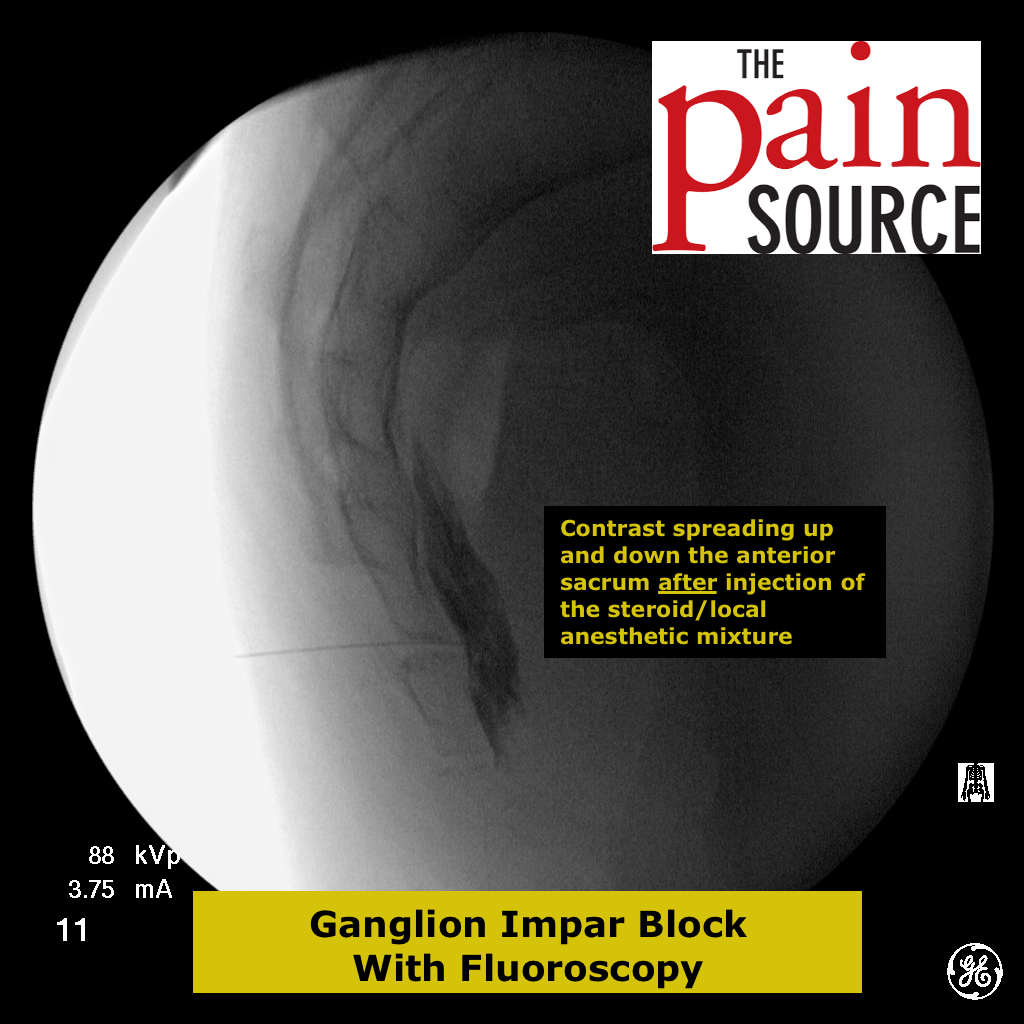
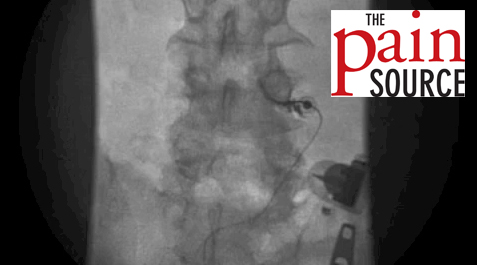
Right L4 Transforaminal Epidural Steroid Injection
The use of electromyography to predict functional outcome following transforaminal epidural spinal injections for lumbar radiculopathy.
Fish DE, Shirazi EP, Pham Q.
Department of Orthopedics, UCLA School of Medicine, Los Angeles, California 90404
Get the abstract here
Summary of Study
- Purpose: to determine if objective EMG findings can predict functional benefit after a lumbar transforaminal epidural steroid injection
- Retrospective chart review
- Study Participants
- Patients who presented to the Veterans Affairs (VA) hospital in Los Angeles between July 1, 2000, and June 30, 2002.
- Pain level and functional status (using the Oswestry Disability Index – ODI) was filled out before the injection, and at a follow-up visit (and these were kept electronically).
- Inclusion criteria
- EMG completion before the procedure with a diagnosis of an L5 or S1 radiculopathy
- Transforaminal epidural steroid injection (TF-ESI) performed at L4 and/or L5
- Symptomatic pain in only one extremity
- Completion of self-assessment surveys before the interventional spine procedure and at follow-up
- To be considered “EMG-positive”
- Evidence of denervation or reinnervation on needle EMG
- Two muscles innervated by 2 nerves from the same spinal cord level needed to be positive .
- Baseline characteristics
- Number of patients = 39
- Age = 60 (mean; ± 12.5 years)
- Methods
- The level of injection was based on the EMG findings, physical examination, magnetic resonance imaging (MRI), and clinical symptoms.
- No patient received more than two levels of injections.
- Injectate used
- 40-mg triamcinolone acetonide (Kenalog) + an unknown amount of 1% lidocaine
- If two levels were injected, the injectate was divided equally between the two levels.
- Results
- The pre-injection ODI (Oswestry Disability Index) scores were essentially equal.
- The pre-injection pain scores on the VAS were similar as well.
- Two groups
- EMG-positive patients
- 18 patients
- Post-injection ODI improvement = 7.11
- EMG-negative/normal patients
- 21 patients
- Post-injection ODI improvement = 3.2
- The post-injection VAS scores were improved after the injection, but the difference between the groups was not statistically different.
- Limitations of the study
- No evaluation of medications taken or changed during the pre- and post-injection ODI
- No comparison of prior surgical interventions to the lumbar spine
- No standardized time between symptom onset and EMG testing
- Not a heterogenous group of patients
- The injectionists were not blinded to the EMG results
- Conclusion
- Patients undergoing transforaminal epidural steroid injections show greater functional improvement if they have positive EMG findings of lumbar radiculopathy.
- Analog pain scores do not help in the decision-making of treatment options for patients with lumbar radiculopathy.
- This study shows the diagnostic value of needle EMG in the prognostic success of patients prior to lumbar TF-ESIs, while simple pain scores are of little value.
Future Research
- Evaluate the psychological and medication factors that may determine a patient’s relief from lumbar epidural steroid injections.
- Also look at interlaminar vs transforaminal ESI relief in EMG-positive vs EMG-negative patients.
Related Content:
Posted in EMG Findings and Epidural Benefits, Journal Club, Lumbar spine
Posted on 21 November 2010. Tags: 20550, CPT code, depo-medrol, ICD-10 code, ICD-9 code, Kenalog, steroid, technique, tendon sheath, trigger finger, trigger thumb, volar flexor tendinitis
By Chris Faubel, MD –
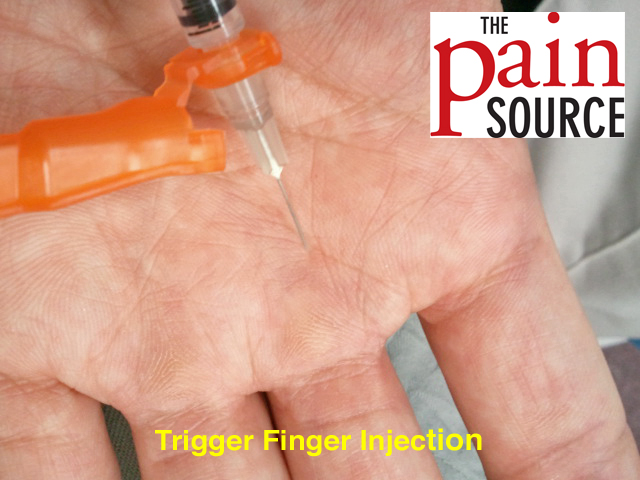
aka “trigger thumb injection”, “trigger digit injection”
Indications
- Trigger Finger
- ICD-9 code:
- 727.03 “trigger finger” (acquired)
- ICD-10 code:
- M65.3 “trigger finger“ nodular tendinous disease
CPT code: 20550 “Injection(s); single tendon sheath, or ligament, aponeurosis”
Materials Needed
- Pen – clicking type
- Gloves – non-sterile
- Alcohol swabs (or povidone-iodine)
- Band-aid
- Tuberculin needle/syringe (27-gauge, o.5″ needle with 1-ml syringe)
- Injectate
- 0.3-0.4-ml of 40mg/ml Depo-Medrol or Kenalog
- 0.3-0.4-ml of 1% lidocaine
Technique / Procedure Steps
- Always start with informed consent from the patient, and then a time-out to verify correct patient and injection site.
- Mark the injection site with the pen tip in order to leave an impression in the skin.
- Clean the skin thoroughly with as many alcohol swabs as needed (usually only 1-2 are needed).
- Patient position: Perform lying supine or seated with the hand supinated.
- With the tuberculin needle/syringe, enter the skin a few millimeters either distally or proximally to the nodule (triggering site) at about a 30-degree angle.
- Aspirate to make sure you’re not in any vessel.
- After negative aspiration, inject the full contents of the syringe, unless lots of resistance is met (means intratendinous needle tip position). Withdraw very slightly, or reposition completely, and try again.
- Withdraw the needle after syringe if fully empty, and apply band-aid.
Tips
- Finding the injection site
- Palpate the volar flexor tendon sheath and tendon in the distal palm, feeling for a nodule.
- Finger/extend the triggering digit to find the triggering site and nodule.
- Numbing the skin
- Find out all about “Taking the Sting Out” (of injections) by going here.
- Since I use a tiny tuberculin needle, most patients have no problem with the injection and don’t need any extra lidocaine skin wheal, although some freezing spray may help.
- After the injection
- Have the patient move their involved digit (flex/extend) while you throw away supplies.
- Then, re-palpate the nodule so they can see the immediate results of the lidocaine.
- Explain to the patient that the lidocaine will wear off in an hour or so, and that they will be back to their normal pain until the steroids start kicking in (anywhere from 1-7 days).
- May also ask the patient to not do much repetitive activity with that digit for 12-24 hours.
Related Content:
Posted in Procedures, Trigger Finger, Upper Extremity
Posted on 05 November 2010. Tags: aspiration, corticosteroid, CPT code, depo-medrol, housemaid's knee, ICD-10, ICD-9, injection, Kenalog, pain, prepatellar bursa, prepatellar bursa injection, procedure, steroid, technique
By Chris Faubel, MD –

This patient does NOT have prepatellar bursitis. Image shown only as an example of needle placement.
aka “Housemaid’s knee injection”, “Prepatellar bursitis injection”, Prepatellar bursa aspiration”
Indications
- Prepatellar Bursitis / Housemaid’s Knee
- ICD-9 code:
- 726.65 “prepatellar bursitis”
- ICD-10 code:
- M70.41 “prepatellar bursitis, right knee”
- M70.42 “prepatellar bursitis, left knee”
CPT code: 20610 “Arthrocentesis, aspiration and/or injection; major joint or bursa”
Materials Needed
- Gloves (non-sterile)
- Alcohol swabs (or betadine)
- Band-aid
- Numbing

This patient does NOT have prepatellar bursitis. Image shown only as an example of needle placement.
- Ethyl chloride “numbing” spray
- 27-gauge 0.5″ tuberculin needle with syringe – for the skin wheal
- Fill with 1-ml of 1% lidocaine
- Aspiration
- 20 or 18-gauge 1.5 inch needle with 3-ml syringe [for aspirating and injecting] — may need larger syringe for aspirating
- Injecting
- Same needle as above, with new 3-ml syringe
- 1-ml of 40mg/ml Kenalog or Depo-Medrol
- 1–ml of 1% lidocaine
Note: If the patient has a fever, and/or the skin over the bursa is erythematous, warm, and swollen, it is NOT recommended to inject any steroids.
Technique / Procedure Steps
- Always start with informed consent from the patient, and then a time-out to verify correct patient and injection site.
- Patient position: Perform with patient seated and knees over edge of table, OR, lying supine with the knee slightly flexed (towel roll under knee)
- Mark the injection site with a pen tip to leave an impression mark.
- Clean the skin thoroughly with as many alcohol swabs as needed (usually only 1-2 are needed). Or clean with betadine and allow to dry completely.
- Spray ethyl chloride or other “numbing” spray over the injection site.
- With the tuberculin needle/syringe, enter nearly parallel to the skin over the injection site and create a skin wheal with 0.5ml 0f 1% lidocaine. Then advance the 0.5″ needle in the direction the injection needle with take, and anesthetize the bursa.
- If aspirating, use an 18 or 20-gauge needle and enter perpendicular to skin, into the bursa. Aspirate as much fluid as possible. If only injecting, you can use a 25-gauge needle.
- After aspirating, keep that needle in the bursa, and switch to the corticosteroid/lidocaine syringe.
- Inject the full contents of the syringe. Should flow easily.
- Withdraw the needle after syringe if fully empty, and apply band-aid.
Tips
- Finding the injection site
- The bursa should be rather obvious; but it usually resides over the anterior patella (inferior half).
- Numbing the skin
- Find out all about “Taking the Sting Out” (of injections) by going here.
- As noted above, use ethyl chloride (or other freezing spray), as well as a skin wheal to reduce the pain of this injection.
- After the injection
- Have the patient flex and extend their knee while you throw away supplies.
- Explain to the patient that the lidocaine will wear off in an hour or so, and that they may be back to their normal pain until the steroids start kicking in (anywhere from 1-7 days) — though just aspirating the fluid will help with the pain right away.
- May also ask the patient to not kneel or apply any direct pressure on the patella for 12-24 hours.
Related Content:
Posted in Lower Extremity, Prepatellar Bursa, Procedures
Posted on 03 November 2010. Tags: code, corticosteroid, CPT, depo-medrol, DIP, distal interphalangeal joint, ethyl chloride, finger, ICD-10, ICD-9, injection, Kenalog, osteoarthritis, procedure, Rheumatoid arthritis, steroid
By Chris Faubel, MD –
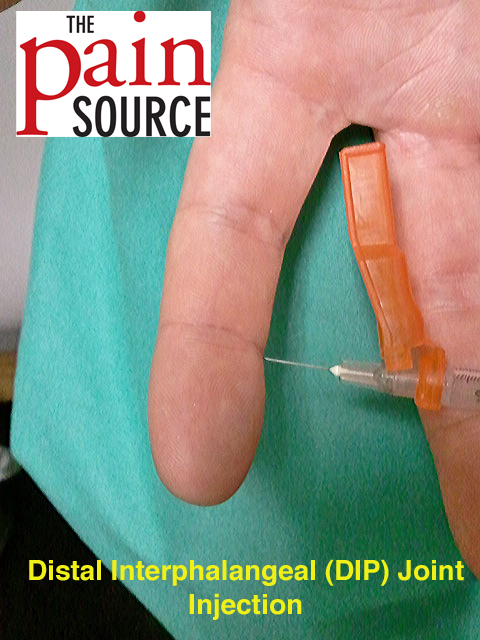
aka. “DIP injection”

Just need to get the needle under the joint capsule.
Indications
- Osteoarthritis (painful) of the distal interphalangeal (DIP) joint
- Rheumatoid arthritis of the distal interphalangeal (DIP) joint
- **see all ICD-9 and ICD-10 codes at end of post
CPT code: 20600 “Arthrocentesis, aspiration and/or injection; small joint or bursa (eg, fingers, toes)”
Read the full story
Related Content:
Posted in Distal Interphalangeal, Procedures, Upper Extremity
Posted on 03 November 2010. Tags: depo-medrol, ethyl chloride, injection, Kenalog, osteoarthritis, painful, PIP, procedure, proximal interphalangeal joint, Rheumatoid arthritis, steroid, technique, tuberculin
By Chris Faubel, MD –

Just need to be beneath the joint capsule. Don't try to get into the middle of the joint.
aka. “PIP injection”
Indications
- Osteoarthritis (painful) of the proximal interphalangeal (PIP) joint
- Rheumatoid arthritis of the proximal interphalangeal (PIP) joint
- **see all ICD-9 and ICD-10 codes at end of post
CPT code: 20600 “Arthrocentesis, aspiration and/or injection; small joint or bursa (eg, fingers, toes)”
Read the full story
Related Content:
Posted in Procedures, Proximal Interphalangeal, Upper Extremity
Posted on 02 November 2010. Tags: big toe, CPT code, depo-medrol, gout, great toe, ICD-10, ICD-9, injection, Joint, Kenalog, metatarsophalangeal, MTP, osteoarthritis, pain, procedure, steps, tuberculin syringe, turf toe
By Chris Faubel, MD –

Just need to get the needle under the joint capsule, not necessarily inside the joint.
aka. “Great toe injection”, “Big toe injection”
Indications
- First metatarsophalangeal (1st MTP) joint painful osteoarthritis
- Gout (in the “great toe” joint) — most common location
- Turf Toe
- **see all ICD-9 and ICD-10 codes at end of post
CPT code: 20600 “Arthrocentesis, aspiration and/or injection; small joint or bursa (eg, fingers, toes)”
Materials Needed
- Pen – clicking type
- Gloves – non-sterile
- Alcohol swabs (or povidone-iodine)
- Band-aid
- Tuberculin needle/syringe OR 1-ml syringe with 25-gauge 5/8″ needle (depending on body habitus)
- Injectate
- 0.5-ml of 40mg/ml Depo-Medrol or Kenalog (or 0.5ml of 6mg/ml Celestone)
- 0.5-ml of 1% lidocaine
Technique / Procedure Steps
- Always start with informed consent from the patient, and then a time-out to verify correct patient and injection site.
- Mark the injection site with the pen tip in order to leave an impression in the skin.
- Clean the skin thoroughly with as many alcohol swabs as needed (usually only 1-2 are needed).
- Patient position: Perform lying supine with the foot off the end of the table, OR, supine with knee bent and foot flat on the table.
- With the tuberculin needle/syringe, enter perpendicular to the skin. If bony resistance is met, redirect the needle until you feel you are inside the joint. Note: Ultrasound may be needed if extensive osteophytes make it difficult to find an entry path. Also, the needle tip does NOT need to be inside the joint; just under the capsule surrounding the joint.
- Aspirate to make sure you’re not in any vessel.
- After negative aspiration, inject the full contents of the syringe. Should flow easily.
- Withdraw the needle after syringe if fully empty, and apply band-aid.
Tips
- Finding the injection site
- Can palpate the joint space best on the medial surface.
- May help to distract the phalanx distally to open the joint space.
- Numbing the skin
- Find out all about “Taking the Sting Out” (of injections) by going here.
- Since I use a tiny tuberculin needle, most patients have no problem with the injection and don’t need any extra lidocaine skin wheal or freezing spray.
- I tell them numbing the skin with lidocaine will probably hurt more than the actual injection.
- Because this is a sensitive area, ethyl chloride “numbing” spray may be used.
- After the injection
- Have the patient move their toe around while you throw away supplies.
- Then, re-mobilize the 1st MTP joint so they can see the immediate results of the lidocaine.
- Explain to the patient that the lidocaine will wear off in an hour or so, and that they will be back to their normal pain until the steroids start kicking in (anywhere from 1-7 days).
- May also ask the patient to not do much activity on that foot for 12-24 hours.
Diagnostic Codes
- First metatarsophalangeal (1st MTP) joint painful osteoarthritis
- ICD-9 codes:
- 715.17 “osteoarthrosis, localized, primary, ankle and foot”
- 719.47 “pain in joint, ankle and foot”
- ICD-10 codes:
- M19.071 “primary osteoarthritis, right ankle and foot”
- M19.072 “primary osteoarthritis, left ankle and foot”
- M79.674 “pain in right toe(s)
- M79.675 “pain in left toe(s)
- Gout (in the big toe joint)
- ICD-9 code:
- 274.0 “gouty arthropathy”
- 274.9 “gout, unspecified”
- ICD-10 code:
- M1a.071 “idiopathic chronic gout, right ankle and foot”
- M1a.072 “idiopathic chronic gout, left ankle and foot”
- M10.071 “idiopathic gout, right ankle and foot”
- M10.072 “idiopathic gout, left ankle and foot”
- Sprain of first metatarsophalangeal joint (turf toe)
- ICD-9 code:
- 845.12 “sprain of metatarsophalangeal (joint) of foot”
- ICD-10 code:
- S93.5 “sprain and strain of toe(s)”
Related Content:
Posted in 1st Metatarsophalangeal Joint, Lower Extremity, Procedures
Posted on 31 October 2010. Tags: bursitis, corticosteroid, CPT code, depo-medrol, ICD-10, ICD-9, injection, Kenalog, pain, pes anserine bursa, pes anserinus bursa, procedure, skin wheal, steps, steroid
By Chris Faubel, MD –

Medial to the patellar tendon and tibial tuberosity (dotted yellow). The bursa lies between the conjoint tendon of three muscles (superficially; sartorius, gracilis, and semitendinosis muscles), and the medial collateral ligament and tibia (deep).
Indications
- Pes anserine bursitis / Pes anserinus bursitis
- ICD-9 code: 726.61 “pes anserinus tendinitis or bursitis”
- ICD-10 code: M70.5 “other bursitis of knee”
CPT code: 20610 “Arthrocentesis, aspiration and/or injection; major joint or bursa”
Read the full story
Related Content:
Posted in Lower Extremity, Pes Anserine Bursa, Procedures
Posted on 31 October 2010. Tags: calcium pyrophosphate, chondrocalcinosis, corticosteroid, cortisone, CPPD, depo-medrol, gout, ICD-10, ICD-9, injection, intraarticular, Joint, Kenalog, knee, osteoarthritis, pain, procedure, Rheumatoid arthritis, shot, skin wheal, steps, steroid
By Chris Faubel, MD –

Medial Approach. Advance needle at about 15-20 degrees from midline.
Indications
- Osteoarthritis of the knee
- Rheumatoid arthritis of the knee
- Gout (in the knee)
- Calcium pyrophosphate dyhydrate (CPPD)
- **see all ICD-9 and ICD-10 codes at end of post
CPT code: 20610 “Arthrocentesis, aspiration and/or injection; major joint or bursa”
Read the full story
Related Content:
Posted in Knee Joint, Lower Extremity, Procedures
Posted on 30 October 2010. Tags: abductor pollicis longus, celestone, CPT code, de quervain's, extensor pollicis brevis, Finkelstein's test, ICD-10 code, ICD-9 code, Kenalog, procedure, radial styloid, stenosing tenosynovitis, steps, tendovaginitis
By Chris Faubel, MD –

Put needle between the abductor pollicis longus and extensory pollicis brevis tendon
Indications
- de Quervain’s tenosynovitis
- ICD-9 code: 727.04 “radial styloid tenosynovitis”
- ICD-10 code: M65.4 “radial styloid tenosynovitis [de Quervain]“
CPT code: 20550 “injection(s); single tendon sheath, or ligament, aponeurosis”
Materials Needed
Related Content:
Posted in De Quervain's, Procedures, Upper Extremity
Posted on 28 October 2010. Tags: bursa, bursae, bursitis, celestone soluspan, corticosteroid, depo-medrol, injection, Kenalog, procedure, rotator cuff tear, Shoulder, shoulder impingement, skin wheal, steps, steroid, Subacromial, tuberculin

Subacromial Bursa Injection - Lateral Approach
By Chris Faubel, MD –
Indications
- Subacromial bursitis
- Rotator cuff tear, degenerative, tenosynovitis
- Shoulder impingement
- **see all ICD-9 and ICD-10 codes at the end of the post
CPT code: 20610
Materials Needed
Related Content:
Posted in Procedures, Subacromial bursa, Upper Extremity