
Tag Archive | "orthopedic test"

Full Can Test – ThePainSource.com

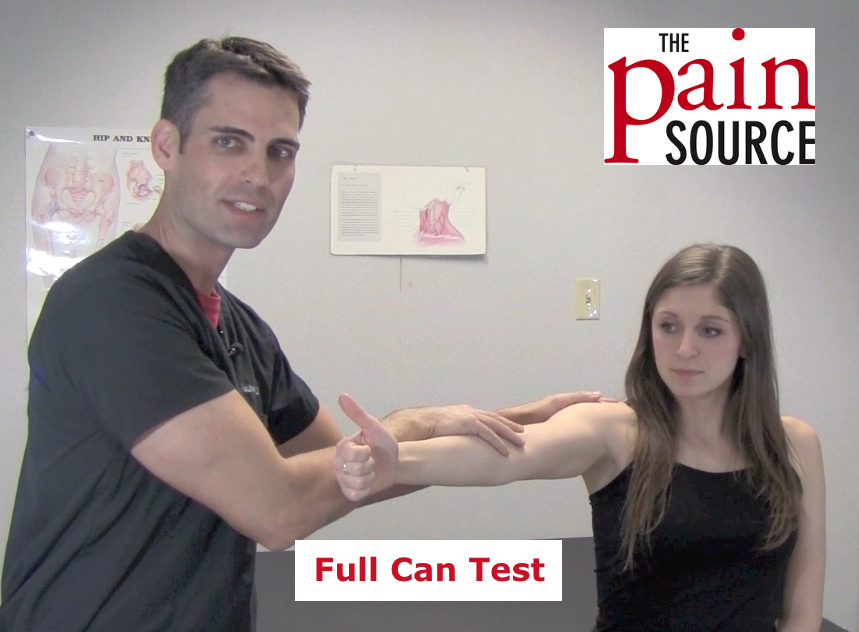
Full Can Test

Patient Position

  • Seated or standing
  • Shoulder elevated to 90° in the scapular plane
  • Forearms fully pronated (thumb UP)

Procedure Steps

  • Examiner instructs the patient to resist downward pressure on the elbow.

Positive Sign / Significance

  • Pain, weakness in shoulder = Supraspinatus tendinitis/tear

Comments

  • The supraspinatus is best isolated with the thumb UP (full can test), rather than with the thumb DOWN (empty can test)
  • The empty can test is more likely to cause pain, and therefore may not show true weakness of the supraspinatus (due to a tear).
    • The full can test is now thought to be better because of this.

Share

Related Content:

Posted in Full Can, Ortho Tests, Shoulder, VideosComments (0)

Empty Can Test – ThePainSource.com

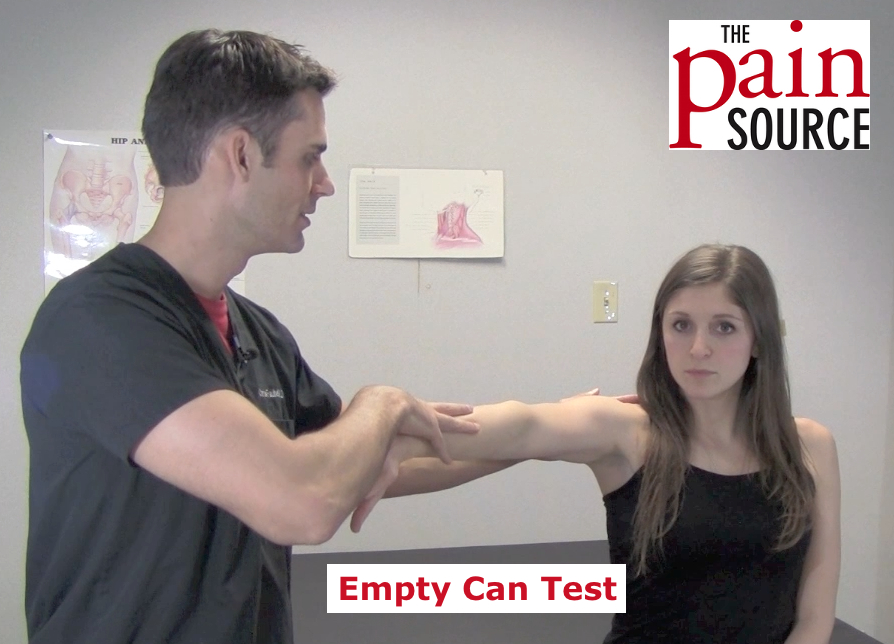
Empty Can Test

aka. “Supraspinatus Press Test”

Patient Position

  • Seated or standing
  • Shoulder elevated to 90° in the scapular plane
  • Forearms fully pronated (thumb down)

Procedure Steps

  • Examiner instructs the patient to resist downward pressure on the elbow.

Positive Sign / Significance

  • Pain, weakness in shoulder = Supraspinatus tendinitis/tear

Comments

  • The supraspinatus is best isolated with the thumb UP (full can test).
  • The empty can test is more likely to cause pain, and therefore may not show true weakness of the supraspinatus (due to a tear).
    • The full can test is now thought to be better because of this.

Share

Related Content:

Posted in Empty Can, Ortho Tests, Shoulder, VideosComments (0)

Speed’s Test

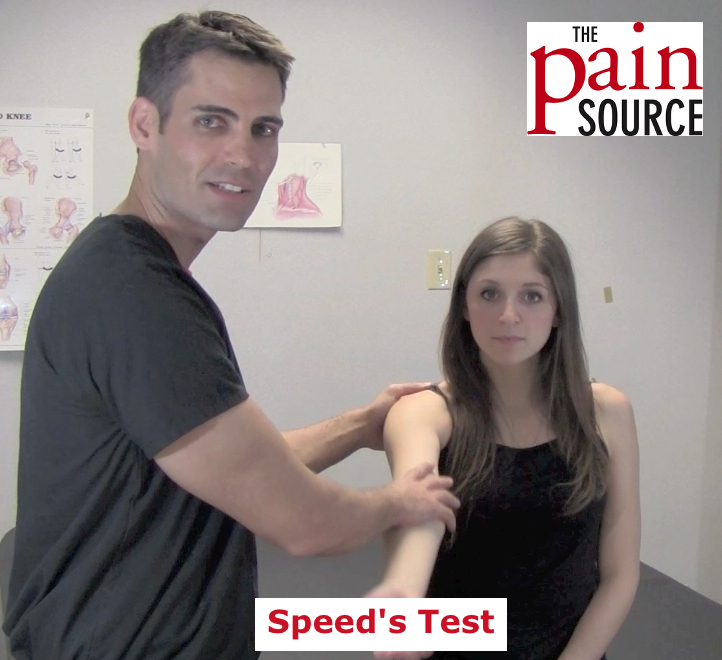
Speed’s Test

Patient Position

  • Seated

Procedure Steps

  • Patient’s arm is forward flexed to ~60°, elbow fully extended, and forearm supinated.
  • Examiner resists further forward flexion by the patient, by applying downward pressure on the forearm.

Positive Sign / Significance

  • Pain over the bicep tendon in the bicipital groove = Bicipital tendinitis or tear (long head of biceps)

Comments

  • May also cause vague shoulder pain with a superior labral anterior-posterior tear (SLAP lesion)

Share

Related Content:

Posted in Ortho Tests, Shoulder, Speed's, VideosComments (0)

Tinel’s Sign at the Wrist

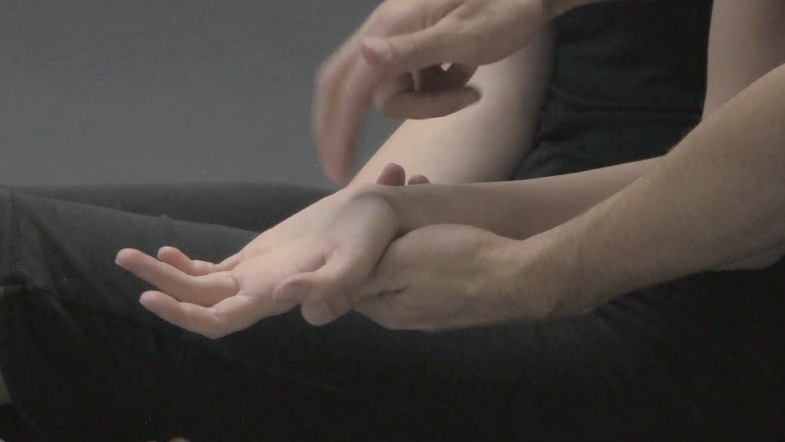
Tinel’s Sign at the Wrist

aka. “Tinel’s Test at the Wrist”

Tinel's Sign at the Wrist

Patient Position

  • Seated (or standing)
  • Elbow flexed, forearm supinated, and wrist in slight extension

Procedure Steps

  • Examiner taps the median nerve as it travels through the carpal tunnel and also just proximal to it [can use reflex hammer or fingers]

Positive Sign / Significance

  • Tingling or pain in the median nerve distribution (thumb, index, middle, and half of the ring fingers) = Carpal tunnel syndrome
Comments
  • Also useful in identifying the most proximal point of nerve regeneration, or the most distal point of nerve degeneration.
  • For more details on carpal tunnel syndrome (CTS), click here
Share

Related Content:

Posted in Ortho Tests, Tinel's, Videos, Wrist/HandComments (0)

Phalen’s Test

Phalen’s Test

Patient Position

Phalen's Test

  • Seated (or standing)
  • Arms abducted, elbows flexed, forearms pronated, and the wrists fully flexed

Procedure Steps

  • Patient is instructed to put the back of both hands together and place them in front of the their chest.
  • Hold the position for 30-60 seconds (or until symptoms appear)

Positive Sign / Significance

  • Reproduction of median nerve symptoms (pain, paresthesias) into the hand in the median nerve distribution = Carpal tunnel syndrome

Share

Related Content:

Posted in Ortho Tests, Phalen's, Videos, Wrist/HandComments (0)

Cozen’s Test

Cozen’s Test

Patient Position

Cozen's Test

  • Seated or standing
  • Elbow extended, forearm pronated, and the wrist extended.

Procedure Steps

  • The patient is asked to keep the wrist extended while the examiner pulls the wrist into flexion.

MODIFICATION (see the video below)

  • Note: This is my own modification of the Cozen’s test.  I haven’t seen this written anywhere, or seen any research noting its effectiveness in diagnosis lateral epicondylitis.  From my experience, this modified maneuver is more sensitive.
  • Roll up a towel or patient gown, such that it fills up their hands in girth.
  • Have the patient grasp the towel firmly with both hands out in front of them.  Then, with their involved side hand, reach over so their firm grasp is with the hand now in flexion (instead of neutral).  With a firm grip with both hands, the patient should now twist the towel backwards into wrist extension with their involved side.

Positive Sign / Significance

  • Pain in the region 1-2cm distal to the lateral epicondyle = Lateral epicondylitis (tennis elbow)

Comments

  • The extensor carpi radialis brevis (ECRB) is the muscle/tendon most involved.
Share

Related Content:

Posted in Cozen's, Elbow, Ortho Tests, VideosComments (0)

Diagnosis of Hip Pathology: The diagnostic validity of hip provocation maneuvers to detect intra-articular hip pathology

Diagnosis of Hip Pathology: The diagnostic validity of hip provocation maneuvers to detect intra-articular hip pathology

By Chris Faubel, MD –

PM&R. 2010 Mar;2(3):174-81.
The diagnostic validity of hip provocation maneuvers to detect intra-articular hip pathology.
Maslowski E
, Sullivan W, Forster Harwood J, Gonzalez P, Kaufman M, Vidal A, Akuthota V.
Department of Physical Medicine and Rehabilitation, University of Colorado Denver, Mail Stop F-493, 12631 East 17th Avenue, Academic Office 1, Room 2513, Aurora, CO 80045, USA. elmaslow@hotmail.com

http://www.pmrjournal.org/article/S1934-1482%2810%2900051-1/abstract

Share

Related Content:

Posted in Hip, Journal ClubComments (1)


Share

TPS YouTube Videos

About ThePainSource.com

ThePainSource.com was started to provide pain medicine information on neuromusculoskeletal conditions, interventional pain procedures, journal article reviews, and other clinically-relevant information to physicians and other healthcare providers specializing in the treatment of patients with pain.